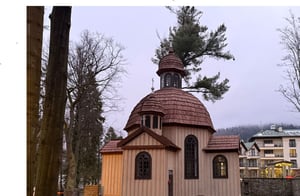
A 19th-century wooden church
Heritage wooden church renovation
The Church of the Transfiguration of the Lord and Our Lady of Częstochowa in Krynica-Zdrój, Poland is a 19th-century wooden chapel of high heritage value. A comprehensive renovation was required after technical and conservation studies identified advanced deterioration of façade boards, roof structures, and selected load-bearing timber elements.
Originally constructed in 1863, the church is defined by vertical timber cladding, wooden shingle roofing, and a domed roof form characteristic of regional wooden sacral architecture. Archival imagery guided the restoration of the original colour scheme, proportions, and detailing. All renovation works were carried out following approval from the historic monuments conservator.
The project aimed to restore the chapel’s original architectural expression while upgrading structural integrity and fire safety in line with contemporary requirements—without altering the building’s historic material character.
Key facts
- Type of Building:
Church - Fire protection class:
B-s1,d0 - Location:
Krynica-Zdrój, Poland - Fire protected:
Wooden façade, roof structures, and load-bearing timber
Conservation approach
The architectural and conservation strategy focused on:
- Preserving the chapel’s original silhouette and material logic
- Limiting material replacement to elements beyond repair
- Restoring historic surface character using archival references
- Integrating fire protection as a material performance requirement, not a visual layer
-1-1-1.png?width=300&name=Untitled%20design%20(5)-1-1-1.png)
Material continuity and repair strategy
The external timber cladding was dismantled to enable full inspection of the structural frame. Structurally compromised elements were selectively replaced with new timber components, matched in species, dimensions, and surface finish.
Façade boards were renewed using vertically oriented timber consistent with the original detailing. Roof works included dismantling the existing shingle covering, preserving and reusing original shingles where possible, and replacing only irreparable elements with new shingles fabricated to match the historic profile and laying pattern.
Temporary breathable protection layers were used during construction to safeguard the timber structure.
-1-1.jpeg?width=300&name=WhatsApp%20Image%202025-11-17%20at%2014-27-16%20(2)-1-1.jpeg)